
from Jonathan Franzen: 'Twitter is the ultimate irresponsible medium'
"Very probably, you're sick to death of hearing social media disrespected by cranky 51-year-olds." But last year he also criticised Facebook, where, he said, "we star in our own movies, we photograph ourselves incessantly, we click the mouse and a machine confirms our sense of mastery. And, since our technology is really just an extension of ourselves, we don't have to have contempt for its manipulability in the way we might with actual people. It's all one big endless loop. We like the mirror and the mirror likes us. To friend a person is merely to include the person in our private hall of flattering mirrors."
from Socially Irresponsible
"To be truly effective, social media requires a different mindset entirely to traditional 'push marketing'," Penton says. "Brands haven't factored this into their thinking when using social media. With correct foresight and planning, social media can be a wonderfully effective and cost-efficient way of developing relationships with end users and achieving bottom-line returns."
The majority of marketers believe that 'doing' social media is more important than listening when engaging on social media platforms, according to CIM's research.
One of the biggest benefits in social media is the ability to see what large amounts of consumers think about a brand, and listening on social media platforms is a vital way of knowing what consumers want. The fact that most marketers think listening on social media platforms is unimportant shows that large businesses have a long way to go in terms of understanding how to leverage these new channels.
"Social media is like teenage sex - everyone wants to do it. When they do they're a bit disappointed, but they practice and it gets much better," says LinkedIn's EMEA marketing solutions director, Josh Graff, in response to the research released by the CIM.
Wednesday, March 07, 2012
Great Social Media Quotes - The Hall of Flattering Mirrors

Friday, April 16, 2010
The Recession and Resulting Shift
"Yes, we still need traditional media partners and integration will become more and more important," Mr. Farley said. "But then post-launch we can't just go away. We have to allocate [social and digital] resources because these different resources change the content and the dialogue of the product after the launch. It's much more manageable, and it impacts how we build the product."
from the Advertising Age article "Ford's Jim Farley Says Recession Was a Blessing for Digital"
Thursday, April 15, 2010
Commenting on Five Reasons Social Media Marketing Comes Last
Earlier today I read "Five Reasons Social Media Marketing Comes Last" which is an excerpt of Shama Kabani's book, The Zen of Social Media Marketing. While I thought overall it was a good read, I don't agree with all the points.
But first let me say that I do agree with this:
"To start with, social media isn’t a marketing platform. It’s a consumer platform."Here are the 5 points listed and my comments in italic:
- Customers look for recommendations and reviews on social media – and then head to your website to make a final purchase decision.
Actually this is reversed. Customers visit your website first to check specs and other facts, but they won't make their decision there. They'll make their decision after reading reviews, perhaps researching some forums and then talking with their friends on Twitter or Facebook to get their opinion.
- You own and control your website, but you don’t own or control any social media platform.
Agreed - but you can definitely influence what occurs on those platforms. - Social media is a great amplifier – and it does just that.
For good and for bad.
- Marketing platforms – advertising, websites, email, e-newsletters, PR, webinars, special events, catalogs, etc. – reach the audience you define. Social media reaches an audience that defines itself.
Not for long. Facebook knows who you are and will most likely be selling that data to companies sooon. Twitter has just instituted their Promoted Tweets and you can be specific on who you want to reach. See http://mashable.com/2010/04/13/virgin-america-promoted-tweets/
- Social media is a broad platform – but it isn’t deep.
This is the one I have the greatest issue with. Sure if you define social media to be Twitter - but that's not the case. Blogs and forums are all forms of social media, and I'm not sure how you can classify those as being shallow.
Also as far as Twitter is concerned - yes it's a social network but it also becoming the backbone of all social networking. Almost all the platforms now have an option to send updates and other bits of information on Twitter. It's like email - except anyone can read it. It's why FourSquare and Gowalla are now viable.
Friday, August 28, 2009
Twitterville Book Party (#tbash)
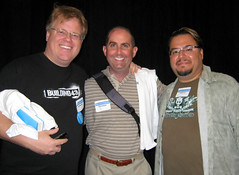
Twitterville Book Party
Originally uploaded by Tony "Frosty" Welch
Robert Scoble (@scobleizer), Steve Rubel (@steverubel) and myself (@frostola) and Shel Israel's #tbash party for his new book "Twitterville"
Wednesday, August 26, 2009
Beyond the Hype: The Roadmap for Social Media

Pic by Howard Friedenberg.
On Wednesday, August 19th I had the honor to host and moderate an amazing panel of social media luminaries. The panel was comprised of:
- Steve Rubel (@steverubel : www.steverubel.com/) is SVP, Director of Insights for Edelman Digital, a division of Edelman
- Richard Brewer-Hay (@ebayinkblog : http://ebayinkblog.com) is Senior Manager, Social Media Strategy & Chief Blogger for eBay Inc.
- Michael Brito (@britopian : www.britopian.com) is a Social Media Strategist at Intel.
- Angela LoSasso (@AngelaAtHp) manages the U.S. Social Media | Social Networking program for HP's Imaging and Printing Group.
We used the hashtag #hpsmr for Twitter.
Articles and pics from event:
- "Listen to the Doers" from @steverubel
- "Beyond the Hype: Roadmap for Social Media’s Future . . . and Ours" by @sharisax
- "Beyond the Hype: The Roadmap for Social Media" by @bremmel
- Liveblogging from @bremmel
- YouTube video from @sharisax
- Flickr set from @britopian
- Pic from @bremmel
- Pic from @secretsushi
- Pics from @frostola
- Pic from @jest1
Tuesday, August 25, 2009
Interview with Shel Israel, author of “Twitterville”

Shel Israel, author of “Twitterville“, graciously agreed to come to HP’s Cupertino campus and talk during our internal bi-weekly Social Media call. Shel is more than just an author - he’s a veteran of Silicon Valley and a wonderful storyteller.
Shel didn't want to do the usual and flip through a presentation. Instead he just wanted to sit down and have a natural conversation. I think it turned out quite well, and we managed to cover a wide array of interesting topics in little less than an hour.
I hope you enjoy it!
Tuesday, August 18, 2009
Social Media Quote of the Day
from "Six million Australians are selling their lives to Facebook"
“Social networking continues to grow in popularity both across Australia and throughout the world,” said Will Hodgman, comScore executive vice president for the Asia-Pacific region. “Social networking is now an essential part of peoples’ daily online routine, providing a level of engagement and reach that far exceeds most other content categories. Understanding how to leverage this audience successfully is both a challenge and significant opportunity for most digital marketers today.”
via @Andrew303 on Twitter.Thursday, August 13, 2009
What about the "In" of Social Media?

Most diagrams you see included in Social Media presentations mostly focus outward. It's probably a spoke and hub model, with the arrows originating from the center then heading outward into the internetosphere. I know because I've drawn a few. "This is how we get our message out." Looks great on the whiteboard, doesn't it?
People are spending a lot of their energy on figuring out how to get out there and make their presence felt in the Social Web. How do we take part in the conversation? Which is really not a bad thing. It means they're past "why do we want to do this" and now at "OK how do we do this?" Progress!
But I'm looking further down the road, and I see some issues. It is a conversation after all, and what happens when customers start talking back? You got their attention, and you know what, they got a few things on their mind. What do you do with that feedback?
The organizations that are adapting Social Media (marketing, advertising, PR) are generally outward focused. But now that they are engaging, they need to be prepared to accept feedback, complaints, etc. Not only do they need to adapt, they need to be able to track and measure the feedback in meaningful and actionable ways. Most likely they will partner with the "in" organizations like support - but they still need to close the loop and be aware of the outcomes.
It will come down to Change Management, and the ability of a corporation to continually encourage adaptability as well as offering education and support. It will require a company to constantly reevaluate processes, and not be afraid to make changes. That being said, it's critical that the company ensure that everyone understands the purpose and benefits of those changes.
For a company who's culture doesn't naturally support these notions, it will be a much tougher road. Their Social Media efforts will be fragmented and disconnected, and will suffer constant setbacks. They will be frustrated and constantly question themselves and their efforts. "What are we doing wrong?"
Only those companies that can demonstrate that they are not only able to talk and listen but able to react to and integrate incoming feedback will be able to build a thriving, successful community (Zappos anyone?). They will know what their customers like, hate and want, and from that alone they will have a distinctive competitive edge.
Social Media is not only about reaching out, it's also about holding the door open and inviting people to come in. Listen, learn, embrace.
Tuesday, August 11, 2009
Twitter for Business: Lessons Learned
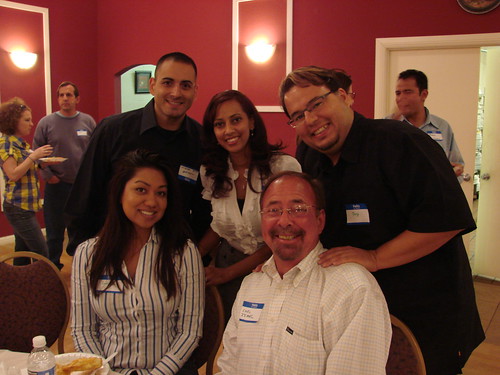
Michael, LaSandra, Tony, Sumaya and Shel
Originally uploaded by Britopian
http://www.meetup.com/CIO-IT-Executives/calendar/10715295/
I was fortunate enough to speak on a panel with LaSandra Brill (Manager, Web & Social Media Marketing at Cisco), Michael Brito (Social Media Strategist at Intel) and Sumaya Kazi (Senior Social Media Manager, Global Communications Division at Sun.)
It was a great atmosphere (Being able to drink wine on stage was big plus) and the audience was definitely engaged. And as an added bonus, I met the amazing Shel Israel. Shel was kind enough to blog about the event.
Thanks to Tatyana Kanzaveli for hosting!
You can view pictures from the event here and over there.
Saturday, June 06, 2009
Who Killed Social Media?
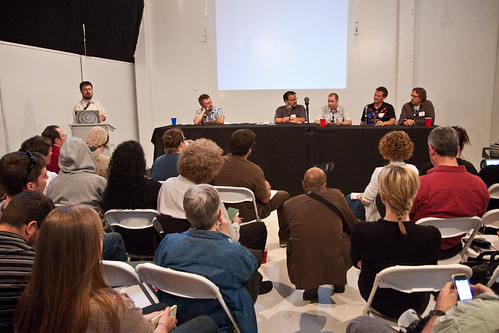
[picture from the Who Killed Social Media - 6/4/2009 collection by ahockley]
I was fortunate enough to be on a panel titled "Who Killed Social Media?" which took place in Portland on Thursday, June 4th. Portland is one of my favorite cities (Hotel Lucia FTW!) and I'm always looking for an excuse to visit. The panel was put together by Nemo Design and Group Y. I'd especially like to thank Dave Allen (@pampelmoose) for inviting me and getting me involved.
The event was sold out, and the crowd was a good mix of marketing, action sports, and social media folks. The atmosphere was energetic and there were good vibes - I'm sure the free beer and wine played a small part.
The panel was composed of:
- Dave Allen (@Pampelmoose : pampelmoose.com) – Director of Insights and Digital Media at Nemo Design
- James Todd (@jwtodd : twine.com) - Software Engineer at Radar Networks, for Twine Matt Savarino (@Ridertech : ridertech.com) - Lead Information Architect at K2 Sports and creator of Ridertech.
- Lee Crane (@leecrane : leecrane.com) – action sports online veteran
and myself. The panel was moderated by Marshall Kirkpatrick (@marshallk), who is Vice President of Content Development and Lead Writer at ReadWriteWeb. Marshall did a fabulous job of moderating. He researched our backgrounds, and from there generated one easy question and one hard question to get the conversation going. Asking questions that were relevant to me made me feel comfortable and relaxed, and also started the thoughts firing rapidly in my brain.
So, there was one statement I made (at the 48:33 mark in Ustream.TV feed) that has generated some interest and the genesis for this blog post:
"SEO or SEM, in my opinion, will be dead as you know it within 6 months"
I'm disappointed that this one comment dominated the online discussion, because in my opinion the points made by my fellow panel members were far more brilliant and insightful.
I didn't make this statement for a wow or shock factor, but because it's something I believe. Also I don't believe its a new revelation. If you keep up with Steve Rubel (@steverubel : Micro Persuasion), Jeremiah Owyang (@jowyang : Web Strategy) and others, you can see where the social web is heading, and what impact it is going to have. Especially on search. And if you're not following them, you really should. They get paid to talk to all the folks who are creating the future, and you get to benefit from their knowledge and insights for free.
The key part of that comment is "as you know it" which was left off the majority of tweets and quotes. I'm glad to see that Kim Toomey (@KimToomey) from Social Search Marketer highlighted that part. I recommend you read her article "Social Media Kills SEO." I don't totally agree with all her points but she understands the gist of what I was saying. Google may have short term memory (for now) - but people don't. Ask Advil, Domino's, and now eMusic. Also my point about the students achieving the #1 rank for the term "social media" in 48 hours proves that the algorithms have changed, and foreshadow what is to come. SEO makes sense and is a basic step everyone should take, but Reputation Management is now critical and necessary. As is your brand's "Experiential Awareness" (quoted from Dave Allen.) Sure your company's website might continue to secure the #1 spot - but what happens when the #2 result is a negative video on YouTube that has 500,000 page views? The question I have is, what do the SEO folks tell their clients when that happens? Tough luck, and don't be stupid?
You may ask yourself why Google has decided to add more weight to the social web. The answer in my opinion is that they realize that when a viral event is happening, people aren't using Google to find out about it. Instead they turn to the searches on Facebook, Twitter, Digg and YouTube. Now that Twitter has enabled real time search, it is a force to be reckoned with (please see Steve Rubel's Visits to Twitter Search Soar, Indicating Social Search Has Arrived.)
I don't have an agenda as far As far as search engine optimization (SEO) and search engine marketing (SEM) is concerned - meaning I don't have any financial interest or connection. I've been building websites for awhile now (13+ years) and SEO is a mainstay on the checklist. I make that disclosure because someone commented "I'll gladly continue to take your clients" on Twitter - which elicited a shoulder shrug from me. I can understand how my comment would upset those who are in the SEO and SEM business. But I also expect those same people to dig a little further (like Kim Toomey), examine the context of my comment and research how search is changing. I also hope that they are educating their customers.
Now I mentioned that SEO will still make sense, but I'm not so sure about SEM. In order for SEM to survive, its going to need to be more context sensitive, and its going to need to understand social relationships. Google's AdSense seems to be having issues. Also, Google and others need to institute a emergency on/off switch for SEM, because I'm sure people are not going to be happy paying money to be associated with a negative social event. For my money, I will pick SEO over SEM any day. And come to think of it, wouldn't I rather pay a bunch of students to get the #1 result in 48 hours, rather than on an ad that people most likely won't click on? Granted that is an extreme, but probably not for long. For other ideas like social ads I would read Jeremiah Owyang's Breakdown: Digg Allows Community To Choose Advertisements.
The standard corporate strategy for the web up until now has been build a slick and well designed website, and then pour money into SEO, SEM, banner and print ads, etc. to drive traffic to that website you just spent all that money building. Who cares what kind of traffic it is, as long as the traffic numbers continue to go up. I know, since I'm guilty of this. The corporate website is where you use to hold court on your brand. But the social web has come along and changed this. (Please see Ford Case Study: Control is an Illusion in the Social Media Age) Companies no longer control their brand. It doesn't matter what companies are saying about their brand. Your brand is being defined by what your customers are saying on their blogs, Facebook pages, Twitter streams, YouTube videos and Yelp reviews. You need to set some of that money aside, and take out that insurance policy in the form of a Community Manager (quoted from Dave Allen.) You need at least to start listening, and discover where the conversations are taking place. Because they are happening. Now.
Before I forget, I mentioned a tool that measured sentiment on Twitter. That tool is Twendz. Type in a search term and sit back watch it go. It takes a little while but its fun to watch. Tac Anderson turned me onto it.
At the end of the day, the web has taught us that you must adapt and evolve, or you will be obsolete and forgotten in a few months. Look at print newspapers (pretty much dead), the corporate music industry (dying) and soon TV (has a nasty cough.) Hopefully one of these days it will get around to War, Bigotry, Hunger ...
Think of a search engine that doesn't care about what your content is or what you say is on your page, but only takes into account what the consensus and sentiment of the social web is pertaining that page. And then think about a search engine that allows the community to vote down (or up) your corporate website in the results. Are you thinking?
Finally, reading through all of the #whokilledSM stream on Twitter reminded me of why I love the social web. People from all over coming together on common platform to discuss, share their passion, engage and criticize.
Thanks again to Nemo Design and Group Y, and thank all of you for your comments and feedback. You can catch me on Twitter or you can view my social web presence at www.frostyland.com.
Oh and I love the ending part of Amber Case's summary:
"The panel ended on a high note, with Dave Allen saying something really awesome ..."
- Recordings, streams and pictures:
- #whokilledSM stream on Twitter
- Who Killed Social Media? on ustream.tv
- Who Killed Social Media - 6/4/2009 from ahockley on Flickr
- 2009_06_04_Group Y Who Killed Social Media from trevoratnemo on Flickr.
- Who killed social media? from turoczy on Flickr.
- Related blog posts:
- Semantics Killed Social Media from AdPulp
- Who Killed Social Media? Reputation, Community Management, and the Future of Branding from Hazelnut Tech Talk
- Social Media Kills SEO from Social Search Marketer
- Who Killed Social Media? from lee crane.
- Cited blogs and reports:
- How 10 people can create a buzz in 48 hours that changed Google search results from the Mindshare Report
- Mindshare Report: An Enterprise Social Media Status Report (Executive Summary) (pdf)
- Domino's: How One YouTube Video Can Ruin a Brand from ReadWriteWeb
- Visits to Twitter Search Soar, Indicating Social Search Has Arrived from Micro Persuasion.
- Major Problems with Google Adsense - Drastic Drop in Adsense Clicks & Earnings from Pro Media Blog
- Breakdown: Digg Allows Community To Choose Advertisements from Web Strategy
- Ford Case Study: Control is an Illusion in the Social Media Age from Social Computing Journal
- eMusic and Sony - The Fiasco - Where Is Their Community Manager? from Pampelmoose


